Inside the VCr

Framework and the underlying theory

The lower transaction costs and high levels of coordination capacity of an economy's leading elite business models, many of which are run by the listed companies measured in the VCr, can be deployed in the service of either value creation or extractive transfers. How firms use this power shapes their contribution to economic growth and prosperity.

Towards an Elite Theory of Economic Development (Casas-Klett, 2026) provides a theoretical foundation for the VCr by distinguishing between first-order value creation—enlarging the overall size of the economic pie—and second-order extractive value transfers—extracting value away from the economic agents that created it.

Firms, especially those running the largest residual income and reward business models in the economy (elite business models), can generate profits through both value creation and value extraction. The VCr looks beyond profitability to assess how much value firms create relative to the value that they appropriate (revenue), by accounting for both the value created and extracted from Stakeholders. A rating above 1.00 indicates that total value creation exceeds value appropriated (revenue).


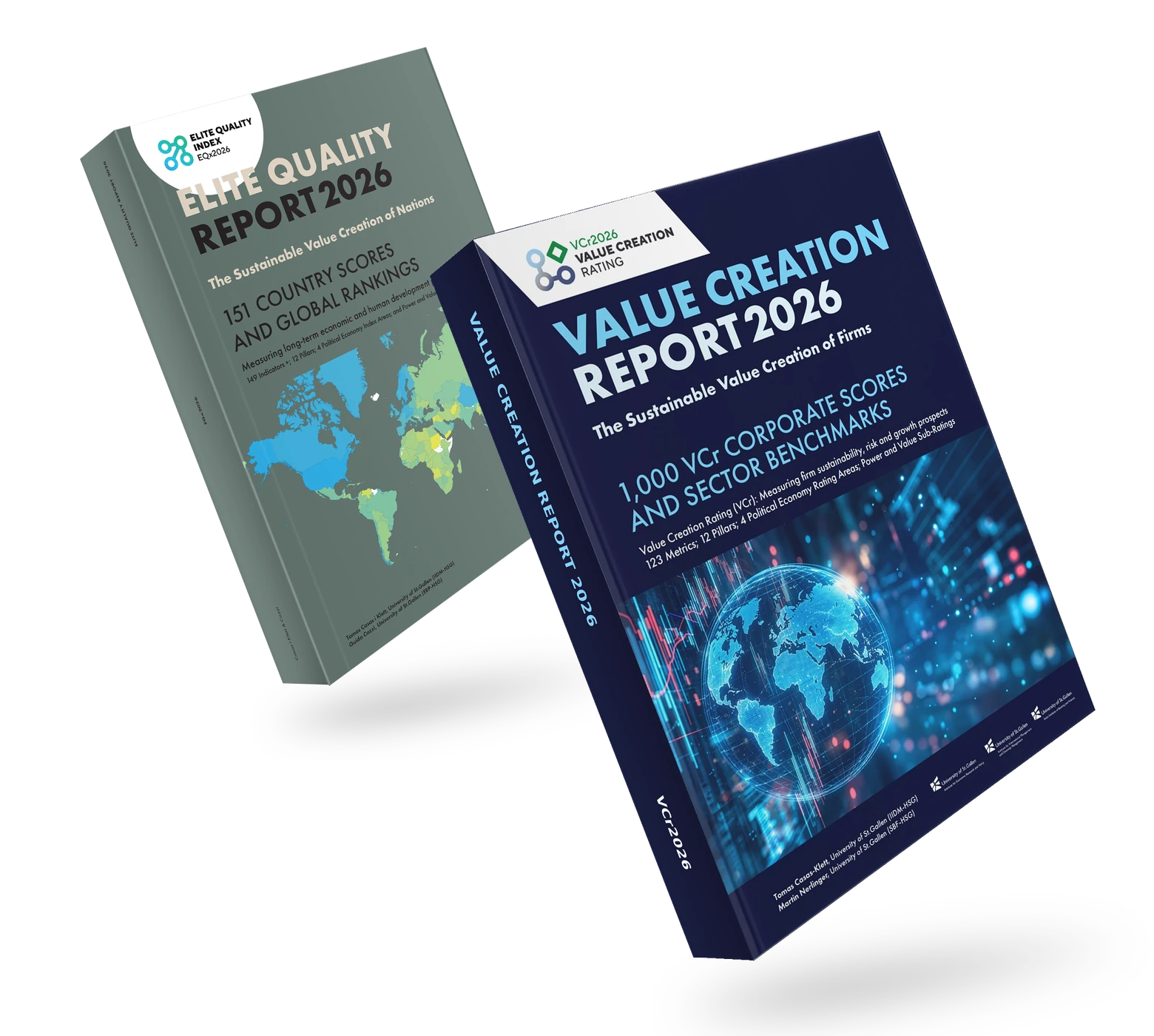
To further familiarize yourself with the theory behind the VCr, the book can be purchased or downloaded free of charge from De Gruyter Brill as an open-access PDF or EPUB.

Firms can either grow the economic pie or size of their slice

The impact of the Sustainable Value Creation (SVC) of firms (as evidenced by their VCrs) on their Stakeholder ecosystem: the firm principal either grows its slice by extracting value at the cost of its Stakeholders or grows the pie benefiting society as a whole and development.

The economy VCr: Low Grow the slice VCr: High Grow the pie

The two Sustainable Value Creation (SVC) measurements

Value Creation Rating (VCr)

The VCr is a comprehensive sustainability measurement that assesses the proportion of value creation and value extraction in a firm's business model. It accounts for both extractive value transfers (transfer-IN) and positive value creation, including the value created but not appropriated that does not appear in the P&L statement (transfer-OUT). In effect, the VCr score describes the relative proportion of inclusive transfer-OUT relative to extractive value transfer-IN.

Expressed as a score with two decimal places, a VCr above 1.00 means that a firm's inclusive transfers (transfer-OUT) exceed its extractive transfers (transfer-IN) and its business model provides more value than it takes from society.

Value Creation Position (VCp)

The simpler VCp assesses the percentage of extractive value transfers in a firm's revenue. The VCp is a precursor to the VCr that only considers the proportion of ‘value created and appropriated’ (Net Value Creation) relative to value appropriated (revenue) by deducting extracted value (transfer-IN). It allows analysts to focus on the size and effects of 'value appropriated but not created' independently from the unmonetized contributions that firms make to their Stakeholders (transfer-OUT).

A VCp of 100% means that a firm generates all of its revenue from value creation and has zero transfer-IN from value extraction, while a VCp of 0% means that a firm generates all of its revenue from value extraction.

VCr Architecture

The architecture of the VCr follows a bottom-up aggregation process across four levels. At the most granular level 4, individual transfer-IN/OUT Metrics are quantified against revenue that is then combined for each of the corresponding 12 Pillars at level 3. These Pillar amounts and scores are then themselves aggregated into the 4 Rating Areas at level 2 and further aggregated into general firm VCr (and VCp) scores at level 1.

  1. Level 1VCr & VCp
    2 Measurements
  2. Level 24 Rating Areas
  3. Level 312 Pillars
  4. Level 4123 SVC Metrics
Level 1

Provides a firm’s overall VCr and VCp scores, representing the highest level of aggregation of its sustainable value creation.

Level 2

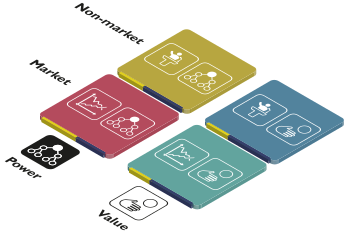
Contains the 4 Rating Areas, which emerge from combining the two firm Sub-Ratings, Power and Value, with the Non-market (political) and Market (economic) dimensions.

Level 3

Contains the 12 Pillars, each representing discrete political economy notions that provide the conceptual homes for the firm-level SVC Metrics.

Level 4

Consists of the SVC Metrics, the foundational, indivisible units of measurement. Each Metric quantifies a specific value transfer (inclusive transfer-OUT or extractive transfer-IN) within the firm’s business model and is assigned to the Pillar that best reflects its impact in the political economy.

Level 1: VCr & VCp scores

What is the key idea behind scoring the 'Sustainable Value Creation of Firms'?

Businesses that create more value than they extract over long periods of time are sustainable because value is always co-created with Stakeholders, and firms also benefit from the value creation of their Stakeholders. Revenue and profits are always generated from 'value created and appropriated' (a first-order productive activity) or 'value appropriated but not created' (a second-order extractive transfer activity). Firms also create unmonetized 'value created but not appropriated' (transfer-OUT) that benefits Stakeholders. The VCr identifies the proportion of all value creation in relation to extractive value transfers by matching these amounts against P&L revenue.

Micro-level firm agency, including risk origination, constitutes GDP and aggregates at the meso-level to determine elite quality. This serves as an antecedent to institutional quality and drives macro-level outcomes such as aggregate productive risk, total factor productivity, and economic growth.

Level 1: VCr & VCp scores

Level 2: VCr Rating Areas (x4)

Level 2 contains the 4 Rating Areas, which emerge from combining the two firm Sub-Ratings, Power and Value, with the Non-market (political) and Market (economic) dimensions. Power is the capacity to successfully bargain and coordinate with Stakeholders to execute firm strategy and facilitates both value creation and the appropriation of value not created. Value is understood as everything that is worth appropriating and is the outcome of first-order productive activities; its creation increases the size of the overall economic pie.

Level 2: VCr Rating Areas (x4)
  • Non-market Power (i) Capacity to influence the (political) non-market and (social) narrative market arenas.
  • Market Power (ii) Capacity to influence the (economic) market arena.
  • Non-market Value (iii) Value creation in the non-market and narrative market arenas.
  • Market Value (iv) Value creation in the market arena.

Level 3: VCr Pillars (x12)

Level 3 is comprised by the 12 Pillars, each representing discrete political economy notions that provide the conceptual homes for the firm-level SVC Metrics. The VCr's 12 Pillars constitute a structured classification system that provides differentiated market-relevant signals about the political economy.

Level 3: VCr Pillars (x12)

Non-market Power (i)

  • State Capture (i.1) transfer-IN Firm power and direct dominance, both actual and attempted, over the state apparatus.
  • Regulatory Capture (i.2) transfer-IN The concrete influence that firms have over regulators and the rules of the game.
  • Human Capture (i.3) transfer-IN How firms exercise influence over employees and associated social structures, such as trade unions, to bolster their own bargaining power.

Market Power (ii)

  • Coalition Dominance (ii.4) transfer-IN Business alliances or arrangements that lead to the dominance of a coalition of firms over a particular sector of the economy or over the economy as a whole.
  • Firm Dominance (ii.5) transfer-IN An individual firm's influence within its specific industrial sector or country.
  • Creative Destruction (ii.6) transfer-OUT A firm's ability to innovate and drive forward industrial and technological transformations in the Schumpeterian sense, disrupting entrenched power structures and the rent-seeking abilities of incumbents.

Non-market Value (iii)

  • Giving Income (iii.7) transfer-OUT A firm's contributions to economic development and the welfare of the societal Stakeholder through business model activities that are aligned with social and political goals, often through voluntary practices.
  • Taking Income (iii.8) transfer-IN Subsidies and other types of political support, often via institutions, that firms receive that could be indicative of value extraction.
  • Unearned Income (iii.9) transfer-IN The value that firms capture but do not create themselves as a result of favorable non-market arrangements, political privileges, and indirect market distortions.

Market Value (iv)

  • Producer Value (iv.10) transfer-OUT A firm's ability to generate positive economic outputs through the production of goods and services.
  • Capital Value (iv.11) transfer-OUT A firm's value creation in the financial markets, including investments for growth.
  • Labor Value (iv.12) transfer-OUT The extent to which a firm's workforce is productive and able to generate value.

Level 4: SVC Metrics (x123)

The foundational level of the VCr architecture is comprised of 123 SVC Metrics. These capture specific firm-level activities, practices, and outcomes that can be quantified in relation to firm revenue and express value creation or its opposite. There are two types of Metrics: those that evidence extractive transfer-IN (value appropriated but not created) and those that describe inclusive transfer-OUT (value created but not appropriated).

Level 4: SVC Metrics (x123)

SVC Metrics Explorer

This tool allows you to explore and filter all the individual SVC Metrics by Rating Area, Pillar, or value transfer type to see exactly what each one measures and how it contributes to the overall VCr.

Value transfer

123 of the 123 SVC Metrics measured in this edition

Filters

Value transfer
Description
Lens
Source
Description
Lens
Source
CodeSVC MetricTransferRating AreaPillarFirms
sc_PJIPeace, Justice and Strong Institutionstransfer-OUT

The Peace, Justice and Strong Institutions Metric assesses whether a company actively supports the United Nations Sustainable Development Goal 16 (SDG 16), which aims to promote peace, justice, and strong institutions.

Non-market PowerState CaptureSociety, Abroad, GovernmentLSEG DATA & ANALYTICS879
sc_POCPolitical Contributionstransfer-IN

Political contributions encompass all monetary donations, support for political candidates, and contributions to political parties made by a company. They include cash donations, loans, sponsorships, fundraising event tickets, advertising, use of facilities, design and printing services, equipment donations, and retainers or jobs for politicians or candidates, including donations made through Political Action Committees (PACs).

Non-market PowerState CaptureGovernment, Narratives, SocietyLSEG DATA & ANALYTICS, MSCI, CRSP/Compustat Merged418
sc_SINSins Revenuetransfer-IN

The Sins Revenue Metric captures the proportion of a company’s total revenue that is derived from controversial or harmful sectors. This includes revenues from alcohol, tobacco, gambling, firearms, and military contracting. Both direct product sales and related service or licensing income are included.

Non-market PowerState CaptureCustomers, SocietyLSEG DATA & ANALYTICS, RepRisk893
sc_SOEState Owned Enterprisestransfer-IN

A State Owned Enterprise (SOE) is an entity that is owned or controlled by a government that holds more than 50% of the voting shares or possesses a golden share that grants it veto power over certain decisions.

Non-market PowerState CaptureGovernment, ShareholdersBloomberg941
rc_LOCLobbying Contributionstransfer-IN

Lobbying contributions refer to the money spent by a company to influence public policy and government decisions in favor of the company’s interests. These expenditures can provide firms with access to exclusive information, government contracts, grants, subsidies as well as favorable policies and regulations.

Non-market PowerRegulatory CaptureGovernment, NarrativesLSEG DATA & ANALYTICS, LobbyView, EU Transparency Register522
rc_LIELitigation Expensestransfer-IN

The litigation expenses Metric encompasses all costs incurred by a company due to legal proceedings, including attorney fees, court costs, settlements, and fines. These expenses are reported by the company and describe the financial impact of legal disputes.

Non-market PowerRegulatory CaptureGovernmentLSEG DATA & ANALYTICS, Compustat163
rc_CRFCorruption Finestransfer-IN

Corruption Fines captures the total monetary amount paid by a company as a result of corruption scandals, bribery cases, or related forms of financial fraud. This includes both domestic and international penalties imposed by regulatory or judicial authorities.

Non-market PowerRegulatory CaptureGovernment, SocietyLSEG DATA & ANALYTICS, RepRisk495
rc_CRTCorruption Trainingtransfer-OUT

Corruption Training measures whether a company has established employee training programs on anti-bribery, anti-corruption, and compliance standards. It captures both the existence and the scope of such initiatives.

Non-market PowerRegulatory CaptureEmployees, GovernmentLSEG DATA & ANALYTICS, MSCI, RepRisk906
rc_HRSHuman Rights Scoretransfer-OUT

The Human Rights Score Metric evaluates the extent to which a company has formal human rights policies, aligns with international standards such as the UN Guiding Principles on Business and Human Rights, and is free from major related controversies.

Non-market PowerRegulatory CaptureSociety, Employees, SuppliersLSEG DATA & ANALYTICS, MSCI879
rc_CLCChild Labor Controversiestransfer-IN

The Child Labor Controversies Metric captures reported incidents or allegations of child labor within a company’s operations or its supply chain. This includes verified NGO reports, media investigations, and regulatory findings.

Non-market PowerRegulatory CaptureEmployees, Suppliers, AbroadLSEG DATA & ANALYTICS, MSCI, RepRisk990

Reports to download

The Value Creation Report (VCr) collection (including firm scorecards, datasets, and expert analysis).

All annual reports

Business Model Sustainable Value Scorecard

The Business Model Sustainable Value Scorecard maps the business model onto the political economy. Its two dimensions of Power (bargaining) and Value (creation/transfer) are applied to both the Non-market and Market arenas to yield the four Rating Areas and their 12 Pillars. It depicts how firms create or appropriate value by competing in markets and bargaining with the state, regulators, and society at large. The scorecard translates the elite theory of economic development into a visual structure to support decision-making. The practice-oriented literature on business models suggests that "a visual model or artifact" can "assist strategic managers in thinking about how they can act" (Simonse, 2014, p. 67). The Business Model Sustainable Value Scorecard is such an artifact.

The Business Model Sustainable Value Scorecard provides a framework that can be utilized in a number of ways such as assisting in transformational leadership, and, at the methodological level, supporting the conceptual classification and determination of Metrics and the judgments that need to be made on their relative weighting after monetary equivalence and calibration factors are established (VCr Methodology, Stage II).

The Business Model Sustainable Value Scorecard

Inclusive value transfer-OUT ‘Value created but not appropriated’ Extractive value transfer-IN ‘Value appropriated but not created’

I. Power (bargaining)

Non-market Power (i)

Capacity to influence the (political) non-market and (social) narrative market arenas

  • (i.1) State Capture 4 Metrics
  • (i.2) Regulatory Capture 8 Metrics
  • (i.3) Human Capture 13 Metrics

Market Power (ii)

Capacity to influence the (economic) market arena

  • (ii.4) Coalition Dominance 4 Metrics
  • (ii.5) Firm Dominance 21 Metrics
  • (ii.6) Creative Destruction 9 Metrics

II. Value (creation/transfer)

Non-market Value (iii)

Value creation in the non-market and narrative market arenas

  • (iii.7) Giving Income 9 Metrics
  • (iii.8) Taking Income 13 Metrics
  • (iii.9) Unearned Income 11 Metrics

Market Value (iv)

Value creation in the market arena

  • (iv.10) Producer Value 10 Metrics
  • (iv.11) Capital Value 12 Metrics
  • (iv.12) Labor Value 9 Metrics

The Business Model Sustainable Value Scorecard and its 2 Sub-Ratings, 4 Rating Areas and 12 Pillars (adapted from Exhibit 2, Casas-Klett & Nerlinger, 2023)

Stakeholders

In the Sustainable Value Creation (SVC) framework, a firm's business model is conceptualized as an embedded bundle of principal-stakeholder relationships that co-create value. The VCr2026 operationalizes this key understanding across 12 value co-creation Stakeholder types, listed here in order of the weight that their primary Metrics carry in the rating. The Stakeholder weights will likely be adjusted as new Metrics are added to the VCr in the future.

When a firm principal leverages power advantages to extract unearned rents from weaker Stakeholders in the value co-creation process (for example, through the suppression of wages, monopoly pricing, tax breaks, or unpriced carbon emissions), the business model extracts value to 'grow its slice' of the economic pie at the expense of others. On the other hand, when inclusive value creation exceeds extraction the business model 'grows the pie' for the overall economy and society at large.

Source: Visual 1.6: The principal and its 12 value co-creation stakeholders, in Casas-Klett & Nerlinger, 2026

Themes

To organize the complexity of sustainable value creation, the VCr introduces a thematic structure consisting of 17 Themes across seven domains: Finance (FIN), Management (MAN), Operations (OPE), Governance (GOV), Environment (ENV), Society (SOC), and Technology (TEC).

These Themes do not replace the VCr architecture, but add an additional lens to translate the Metrics into categories familiar to managers, analysts, investors, and the finance industry.

As a single Metric can address more than one business issue, each may be mapped to between one and three Themes. Together, the Themes, Pillars, and the Stakeholder types allow the same data to be examined from three highly discrete perspectives: where do value and risk transfers originate from in the political economy (Pillars); what counterparties win or lose from the transfer of value and risk (Stakeholders); and which business and financial industry-relevant issues are addressed (Themes).

VCr Methodology:
Three stages from concept to output

The VCr is an ongoing research project centered on identifying suitable SVC Metrics to describe either inclusive 'value created but not appropriated' (transfer-OUT) or extractive 'value appropriated but not created' (transfer-IN).

Firm-level VCr (and VCp) scores are the result of a three-stage process to identify and determine the relative importance of SVC Metrics.

I

Conceptual determination

The conceptual determination of the SVC Metrics: Any Metric should express the inclusive value creation or extractive value transfer effected by a firm business model (i.e., value transfer-IN or value transfer-OUT), be associated with one of the 4 Rating Areas, and assigned to one of the 12 Pillars.

II

Quantification (input)

The quantification of the SVC Metrics (input): The research-intensive and highly technical input process includes choosing the Metric assessment method; selecting the data sources, collecting and preparing the data; and making calibration judgments to determine 'monetary equivalence' with the appropriate 'calibration factor'.

III

Calculation (output)

The calculation of the SVC measurements (output). The output process is also highly technical and includes weighting, aggregating, and implementing various schema to transform individual Metrics into the VCp and VCr sustainable value creation measurements.

Weighting schema

The VCr follows a fixed and theory-driven weighting scheme that mirrors its architecture. At the top, value creation outweighs power: the Value Sub-Rating carries two-thirds of the overall weight and the Power Sub-Rating one-third, as power signals potential future extraction that may or may not be realized. Within each Sub-Rating, the economic Market dimension carries a weight of two-thirds and the political Non-market dimension one-third, as markets are the more direct arena in which value is appropriated and converted into revenue and profit. Together, these considerations give the four Rating Areas their respective weights: Market Value 44.44%, Market Power and Non-market Value 22.22% each, and Non-market Power 11.11%.

Each Rating Area weight is divided equally among its three constituent Pillars with one deliberate exception: in Market Power, the Schumpeterian Creative Destruction Pillar receives a larger share of half the total weight, assuming more importance than the two dominance Pillars.

Within each Pillar, all SVC Metrics are weighted equally, but the decisive factor is the calibration process: each Metric is calibrated into a revenue-equivalent amount and it is the size of this, rather than a specified weight, that ultimately determines a Metric’s impact on a firm’s VCr score.

Stakeholders and Themes carry no weight but provide alternative analytical lenses on the data.

Elite Quality Index (EQx) reports

The Elite Quality Index (EQx) is the VCr’s sister report at the country level. Published annually since 2020 and now in its seventh edition, the EQx uses 148 Indicators and the same Power and Value architecture as the VCr to rank 151 nations in terms of how much value their elites create rather than extract.

Visit the EQx website