


VALUE CREATION REPORT (VCr2026)

Value Creation Rating (VCr):
Does this firm create more value than it extracts?

The VCr2026 assesses the world’s 1,000 largest listed firms by weighing their value creation and inclusive transfers to stakeholders (transfer-OUT) against their extractive value transfers away from stakeholders (transfer-IN).

1,000 top listed firms
123 SVC Metrics
3rd annual edition

VCr Firm Scorecards

Firms are assessed in terms of the full value they create. Explore firm VCr ratings and benchmark their sustainable value creation against sector-VCr and country-VCr baselines. There are 9 rating Classes—ranging from the highest band of V1 to the lowest band of Z2—that translate the VCr scores onto a scale comparable to credit ratings.

Rtx Corporation

V41.04

US75513E1010, Industrials, United States

VCr rank 334 / 1,000

extractiveLowestZ2Z1X3X2X1

1.00

generativeV4V3V2V1Highest

extractive
Value Transfer tIN
generative
NetVC + tOUT Value Creation
country-VCr Baselinecountry-VCr🇺🇸 1.01United States
sector-VCr Baselinesector-VCr1.00Industrials
VCr
1.04
A firm’s total value creation relative to the value it appropriates as revenue.
VCp
96.0%
The percentage of a firm’s revenue that is genuine value creation and does not stem from extractive transfers.
transfer-IN
4.0%
‘Value appropriated but not created’ as a share of revenue.
transfer-OUT
7.9%
‘Value created but not appropriated’ as a share of revenue.

What is the VCr?

A double-materiality sustainability measurement that quantifies the proportion of value creation to value transfers in relation to all value appropriated (revenue).

VCr & VCp (Architecture Level 1): Revenue vs Value Creation & Transfers

Value Creation Position (VCp)

The VCp measures the impact of extractive value transfers relative to revenue

VCp 92.6%

Value Creation Rating (VCr)

The VCr measures the proportion of value creation to value transfers relative to revenue

VCr 1.09

VCr framework & theory The Elite Quality Index (EQx)

Understanding the VCr

What is the VCr?

The VCr expresses the proportion of all value creation relative to all value appropriated (revenue). Founded on the principles of double materiality, it provides signals on a company's long-term financial prospects and its impact on society, the environment, and all of its stakeholders.

What is value creation?

Value creation is the sum of all first-order productive activities. It is comprised of Net Value Creation (‘value created and appropriated’, as included in the P&L statement) and inclusive value transfer-OUT (value created by the firm that benefits stakeholders but is not monetized in the P&L statement). Risk origination is an essential element in value creation.

What is risk origination?

The advancement of Knightian uncertainty through which genuinely new value is brought into existence. Each VCr scorecard carries the tagline Revolutionizing Risk by Weighting Value. Risk management simply preserves existing value, while undertaking uncertainty and originating risk creates new value. Risk transfers, socializing losses, or benefiting from not having ‘skin in the game’ is a form of value extraction.

What is value extraction?

Value extraction is comprised of second-order value transfers and operationalized as transfer-IN. A firm uses its asymmetrical bargaining power differentials accumulated across the market, non-market, and narrative arenas, to appropriate value generated by its stakeholders without providing the quid pro quo of productive output.

Examples include the suppression of wages, monopoly pricing, tax breaks or unpriced carbon emissions.

How is the VCr calculated?

VCr = [revenue − transfer-IN(revenue) + transfer-OUT(revenue)] / revenue

A firm’s revenue is readily available from its standard financial statements. Transfer-IN and transfer-OUT amounts are then quantified to establish the value flowing between the firm and its stakeholders in both directions, through the bottom-up aggregation of calibrated SVC Metrics across the firm’s complete operational footprint.

How to interpret a VCr score?

The critical balancing point is a VCr score of 1.00. At 1.00, inclusive transfer-OUT exactly offsets extractive transfer-IN; above 1.00, the score is deemed to be ‘generative’ as total value creation exceeds value appropriated (revenue); below 1.00 it is deemed to be ‘extractive’ as the business model appropriates more value than it creates.

Firms, organizations, or elite business models with a Generative score (VCr > 1.00) create more value for their stakeholders than they appropriate as revenue, directly advancing economic and human development.

How do I interpret a VCr rating Class?

The VCr scale places a firm in one of nine rating Classes, comparable in form to the long-term credit-rating scales of Moody's, S&P and Fitch. V1–V4 constitute the 'Generative' category, while X1–X3 and Z1–Z2 constitute the 'Extractive' category.

How do we quantify value creation?

The VCr quantifies value creation through transfer-OUT SVC Metrics that capture revenue-equivalent ‘value created but not appropriated’. By linking granular operational data to revenue, the VCr framework measures the value flowing from the firm principal to its many stakeholders, transforming sustainability from a qualitative concept into calibrated, revenue-equivalent figures.

How do we quantify value extraction?

The VCr quantifies extraction through transfer-IN SVC Metrics that capture revenue-equivalent ‘value appropriated but not created’. By converting operational, social, financial, political, and environmental extraction indicators into calibrated financial equivalents, the VCr framework looks beyond what statutory accounting aims to achieve to measure how much of a firm’s revenue depends on extractive transfers from stakeholders rather than on value creation.

What is the practical aim of the VCr project?

‘Revolutionizing Risk by Weighting Value’. Our key ambition for the VCr is to equip managers, investors, and policymakers with an innovative toolset to analyze risk origination and weigh all of the value that is created from it. The result is a novel framework that provides firms and institutions with a new understanding of sustainability and enables them to pursue transformational leadership.

What is the significance of the VCr project for the political economy?

The VCr reflects the distinction made in the Elite Theory of Economic Development (ETED) between first-order productive activities, which grow the overall economic pie, and second-order transfer activities, which redistribute value already created to grow the economic slice of the extracting entity. The four Rating Areas map each SVC Metric to the political economy, directly linking the value flows of a business model to a broad set of societal implications.

What is the relationship between the Value Creation Rating (VCr) and the Elite Quality Index (EQx)?

While the VCr measures sustainable value creation at the micro-level of the firm, the Elite Quality Index (EQx) aggregates these and other leading business models at the meso-level, providing a framework to predict macro-level outcomes such as economic growth and human development.

VCr vs traditional ESG: A direct comparison

While mainstream ESG ratings score firm disclosures and company policies, they do so largely without monetary values or a focus on power. The VCr goes deeper by examining the business model itself; quantifying in P&L-linked monetary terms whether a firm’s revenue is built on value creation and productive risk origination or relies on extractive transfers enabled by bargaining power asymmetries.

Feature Mainstream ESG Value Creation Rating (VCr)
Handling of Risk Passive risk avoidance Focuses on minimizing operational risk and maintaining a defensive posture. Productive risk origination Rewards firms that use purposeful uncertainty to create new value and have 'skin in the game' and abstain from transferring the losses from bad bets.
Locus of Analysis Disclosures, policies, & Metrics Evaluates a company's reported policies, compliance structures, targets, and a range of ESG Metrics (emissions, diversity, controversies, etc.). The business model & P&L Evaluates whether a company uses value creation or extractive transfers to generate its revenue and profits.
Core Logic Mostly risk- and harm-focused Concentrates on avoiding or managing negative environmental and social impacts that could hurt the company. Focuses on positive value creation Even when measuring value extraction, the VCr emphasizes the value that was first created by principals, while also evaluating value that was created but not monetized.
Materiality Model Single materiality (primarily) Focuses primarily on how environmental and social issues affect the company's own risks and profits. Double materiality (internalized) Quantifies and prices the company's impact on a wide range of stakeholders (both positive and negative externalities) and its long-term financial returns.
Metrics Types P&L independent Largely use non-monetary scores and indicators. Intendedly linked to P&L SVC Metrics are linked to the P&L and quantified as monetary equivalents to align with standard financial accounting practices.
Power Largely silent on power The focus is on disclosure rather than on the monetary rents obtained through barriers and bargaining power. Power is viewed as potential extraction Quantified income from extractive value transfers is obtained from bargaining power differentials caused by market concentration or regulatory capture (transfer-IN).
Ultimate Objective Reputation signaling Strives to signal a firm's values to stakeholders, often leading to greenwashing and symbolic gestures. Durable returns Aims to maximize value creation, giving management and capital providers a tool to optimize strategic stakeholder relationships and the allocation of capital.

VCr Architecture: 123 Metrics become one value creation score

Measurements: at the top of the VCr architecture are the two main firm-level SVC (Sustainable Value Creation) measurements: the VCr and the VCp.

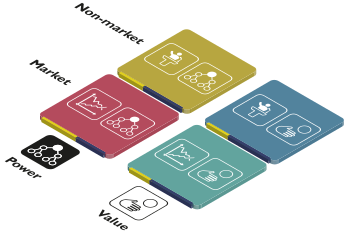
Rating Areas: the four Rating Areas are formed by the Power and Value Sub-Ratings, each of which have Non-market and Market dimensions, linking every Metric to the political economy and society as a whole.

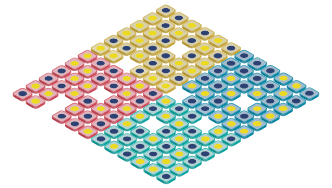
Pillars: each SVC Metric is assigned to one of 12 Pillars, each representing a distinct element in the political economy, with three Pillars contributing to each of the four Rating Areas.

Metrics: the SVC Metrics quantify transfer-IN and/or transfer-OUT. Each draws on its own independently sourced dataset and establishes a monetary amount that matches or is traceable to entries in the P&L statement.

123 SVC Metrics
12 Pillars
4 Rating Areas
2 Measurements
  1. Level 1VCr & VCp
    2 Measurements
  2. Level 24 Rating Areas
  3. Level 312 Pillars
  4. Level 4123 SVC Metrics
Level 1

Provides a firm’s overall VCr and VCp scores, representing the highest level of aggregation of its sustainable value creation.

Level 2

Contains the 4 Rating Areas, which emerge from combining the two firm Sub-Ratings, Power and Value, with the Non-market (political) and Market (economic) dimensions.

Level 3

Contains the 12 Pillars, each representing discrete political economy notions that provide the conceptual homes for the firm-level SVC Metrics.

Level 4

Consists of the SVC Metrics, the foundational, indivisible units of measurement. Each Metric quantifies a specific value transfer (inclusive transfer-OUT or extractive transfer-IN) within the firm’s business model and is assigned to the Pillar that best reflects its impact in the political economy.

Consult the VCr dataset in your own language

The chatbotVCr is an interactive conversational AI service that transforms the VCr data on the world’s 1,000 largest listed firms into an accessible decision-support tool for corporate executives, investors, financial analysts, and researchers. By combining structured VCr datasets with Retrieval-Augmented Generation (RAG) across VCr methodology documents, it enables company lookups, cross-firm comparisons, and automated benchmarking against the sector-VCr and country-VCr baselines. chatbotVCr analyzes corporate business models across 12 Pillars, 17 Themes, and 12 Stakeholder categories to identify the factors underlying a company’s VCr and VCp scores. This AI service distinguishes inclusive value transfers (transfer-OUT) from extractive transfers (transfer-IN), supporting sustainable investment research and helping management identify actionable levers for business model transformation.

Ask chatbotVCr

Which ten firms create the most value for Customers?

chatbotVCr

Enel ranks first in terms of value created for the ‘Customers’ stakeholder type in the VCr2026 dataset. The ranking uses value created for Customers but not monetized by the firm, expressed as a share of its revenue, not the firm's overall VCr score.

Rank Firm
1 Enel
2 Schneider Electric
3 CNAPX.TECH.CO. LTD.
4 Iberdrola
5 Marvell Technology

Show me the top ten value creators in Financial Strength & Risk (FIN1).

chatbotVCr

Top ten value creators in the Financial Strength & Risk (FIN1), ranked by the share of revenue created for this Theme, not by the firm's overall VCr score.

Rank Firm
1 Prosus
2 Kweichow Moutai
3 Visa
4 SoftBank Group
5 Mastercard

The Overarching Sustainable Value Creation (SVC) Initiative

The Sustainable Value Creation Initiative (SVC Initiative) constitutes a comprehensive approach to double materiality that connects value and risk to a long-term view of the firm and consists of two interconnected projects. First, the VCr focuses on the business model of the firm at the micro-level, rating 1,000 global listed corporations through 123 SVC Metrics. Second, the Elite Quality Index (EQx) ranks the nations of the world in terms of their meso-level elite quality, evaluating 151 countries using 148 Indicators. Both aim to identify the proportion of inclusive value creation in relation to extractive value transfers.

Does this firm create value, or extract it?

The VCr assesses listed firms by measuring their value creation and inclusive transfers against the extractive transfers of their business models, thereby uniquely quantifying transfer-IN and transfer-OUT. Transfer-IN covers all business model practices that appropriate value created by stakeholders (‘value appropriated but not created’); transfer-OUT is the value a firm creates but does not monetize (‘value created but not appropriated’), benefiting specific stakeholder types, including society at large.

3rd edition, 1,000 firms, 123 SVC Metrics

What the VCr does for firms, the EQx does for nations

The EQx, ‘The Sustainable Value Creation of Nations’, ranks countries in terms of their meso-level elite quality: the EQx2026 evaluated 151 nations using 148 Indicators. Both the VCr and the EQx share the key aim of the SVC Initiative: to shed light on the business models that drive sustainable value creation and lead to economic growth and human development.

7th edition, 151 countries, 148 indicators

Join the Sustainable Value Creation Community

Partner with the Foundation for Value Creation

Contribute to the SVC Initiative and its core mandate: the development, refinement, and advancement of practical measurements for sustainable value creation, from the EQx’s measurement of nations to the VCr’s measurement of firms.

Contact us now

Assess your firm using the self-VCr

The self-VCr is a confidential self-assessment survey delivered through a web app. It provides outputs that can support the development of business model strategy and transformational leadership. Firms report unstructured and qualitative data in strict confidence, turning the tacit knowledge held by executives, boards, and investors into structured insights for internal use.

Learn about the self-VCr